Gold price retains intraday negative bias; bullish bias remains amid broadly weaker USD
- Gold price kicks off the new week on a softer note as bulls turn cautious amid trade optimism.
- US fiscal concerns and Fed rate cut bets undermine the USD, lending support to the commodity.
- Any further slide could be seen as a buying opportunity amid a bullish fundamental backdrop.

Gold price (XAU/USD) remains depressed as the latest optimism led by US President Donald Trump's decision to delay the implementation of tariffs on the European Union (EU) continues to undermine safe-haven assets. However, a combination of factors acts as a tailwind for the commodity and warrants some caution before positioning for any meaningful corrective decline from over a two-week high touched on Friday.
Investors remain on edge amid worries over the worsening US fiscal health. Apart from this, bets that the Federal Reserve (Fed) will cut rates further in 2025 drag the US Dollar (USD) to over a one-month low and lend some support to the non-yielding yellow metal. Apart from this, persistent geopolitical risks stemming from the protracted Russia-Ukraine war and conflicts in the Middle East limit losses for the precious metal.
Daily Digest Market Movers: Gold price bulls remain on the sidelines amid receding safe-haven demand
- In a mega U-turn, US President Donald Trump delayed the implementation of a 50% tariff on the European Union from June 1 until July 9. Earlier on Sunday Ursula von der Leyen, president of the European Commission, said that the EU was ready to move quickly in trade talks with the U.S. but needed more time to strike a deal.
- Trump’s sweeping tax cuts and spending bill, which would add an estimated $4 trillion to the federal primary deficit over the next decade, was passed in the lower house last week and will be voted on in the Senate this week. This adds to worries that the US budget deficit could worsen at a faster pace than previously expected.
- Softer-than-expected US Consumer Price Index (CPI) and the Producer Price Index (PPI) released earlier this week, along with a sluggish growth outlook, lifted bets that the Federal Reserve will eventually step in to support the economy. Traders are now pricing in at least two 25 basis points interest rate cuts by the Fed this year.
- Minneapolis Fed President Neel Kashkari said early this Monday that extended tariffs raise the risk of stagflation. The question now is a scale of stagflation, Kashkari added further. Meanwhile, the US Dollar prolongs a two-week-old downtrend and drops to a fresh monthly low, which, in turn, lends additional support to the Gold price.
- Meanwhile, Russian forces launched a massive drone and missile attack across Ukrainian cities, marking the war's largest aerial attack to date. Trump called the attack unacceptable and said that he was considering new sanctions against Russia. Moreover, the continuous Israeli strikes on Gaza keep the geopolitical risk in play.
- The focus now shifts to FOMC minutes, due on Wednesday, which will look for cues about the rate-cut path. Traders will further confront the release of key US macro data – Durable Goods Order on Wednesday, the Prelim GDP, and the Personal Consumption Expenditure (PCE) Price Index on Thursday and Friday, respectively.
Gold price dips towards ascending trend-line support near $3,325 could be seen as a buying opportunity
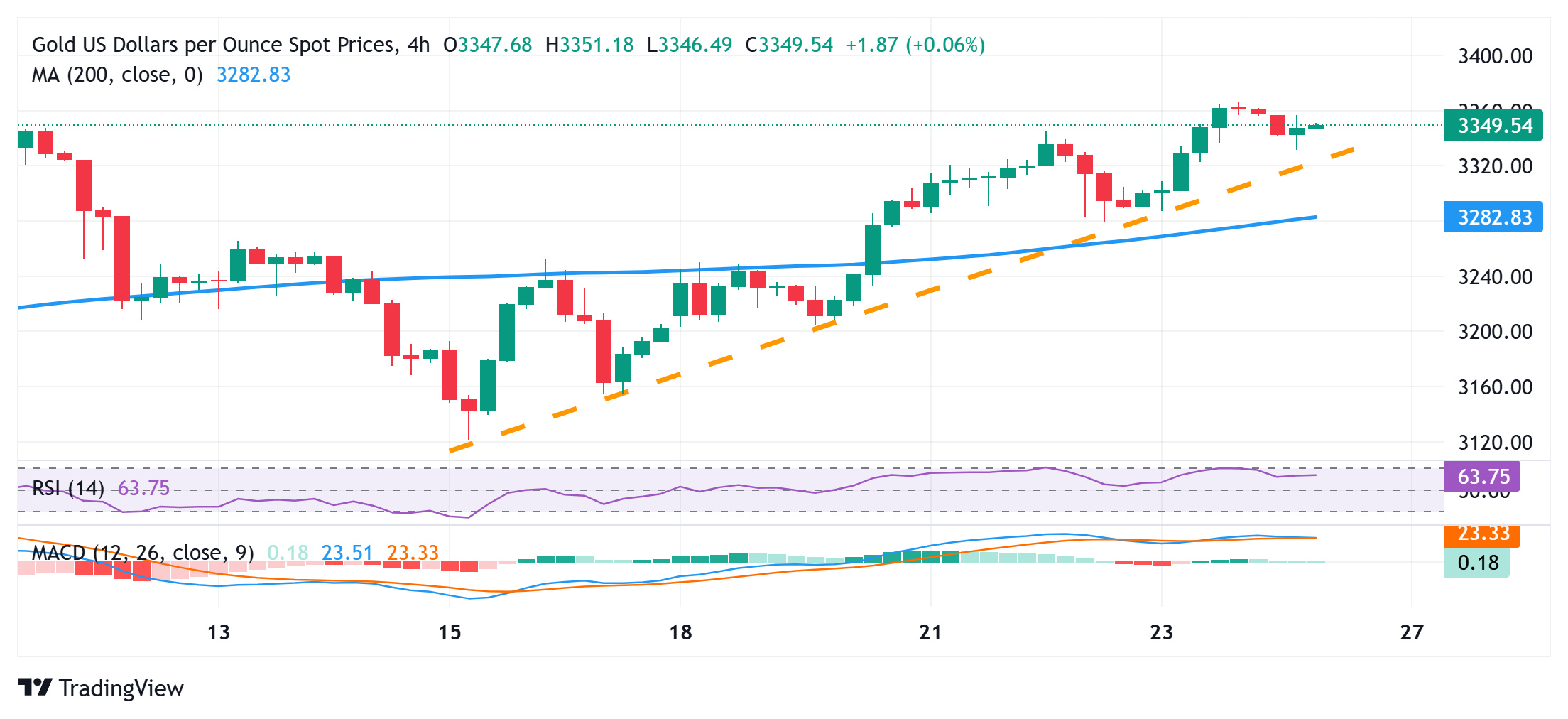
From a technical perspective, the recent move higher along an ascending trendline and positive oscillators on hourly/daily charts validates the near-term positive outlook for the Gold price. Hence, any subsequent slide is more likely to find decent support near the said trendline, currently pegged near the $3,325-3,324 region. A convincing break below, however, might prompt some technical selling and drag the XAU/USD to the $3,300 round figure en route to the $3,283 area, or the 200-period Simple Moving Average (SMA) on the 4-hour chart. The latter should act as a key pivotal point, which if broken decisively should pave the way for deeper losses.
On the flip side, momentum beyond Friday's swing high, around the $3,366 area, will be seen as a fresh trigger for bullish traders and allow the Gold price to reclaim the $3,400 round figure. The next relevant resistance is seen near the $3,430 region, above which the XAU/USD could aim to challenge the all-time peak, around the $3,500 psychological mark touched in April, with some intermediate hurdle around the $3,465-3,470 zone.
Fed FAQs
Monetary policy in the US is shaped by the Federal Reserve (Fed). The Fed has two mandates: to achieve price stability and foster full employment. Its primary tool to achieve these goals is by adjusting interest rates. When prices are rising too quickly and inflation is above the Fed’s 2% target, it raises interest rates, increasing borrowing costs throughout the economy. This results in a stronger US Dollar (USD) as it makes the US a more attractive place for international investors to park their money. When inflation falls below 2% or the Unemployment Rate is too high, the Fed may lower interest rates to encourage borrowing, which weighs on the Greenback.
The Federal Reserve (Fed) holds eight policy meetings a year, where the Federal Open Market Committee (FOMC) assesses economic conditions and makes monetary policy decisions. The FOMC is attended by twelve Fed officials – the seven members of the Board of Governors, the president of the Federal Reserve Bank of New York, and four of the remaining eleven regional Reserve Bank presidents, who serve one-year terms on a rotating basis.
In extreme situations, the Federal Reserve may resort to a policy named Quantitative Easing (QE). QE is the process by which the Fed substantially increases the flow of credit in a stuck financial system. It is a non-standard policy measure used during crises or when inflation is extremely low. It was the Fed’s weapon of choice during the Great Financial Crisis in 2008. It involves the Fed printing more Dollars and using them to buy high grade bonds from financial institutions. QE usually weakens the US Dollar.
Quantitative tightening (QT) is the reverse process of QE, whereby the Federal Reserve stops buying bonds from financial institutions and does not reinvest the principal from the bonds it holds maturing, to purchase new bonds. It is usually positive for the value of the US Dollar.
Author

Haresh Menghani
FXStreet
Haresh Menghani is a detail-oriented professional with 10+ years of extensive experience in analysing the global financial markets.